 The C-section rate in the United States is too stinking high. Luckily the rate has plateaued over the last 2 years, but still nearly a third of all babies enter this world via an abdominal incision.
The reasons for this have been examined by government analysts, insurance companies and patient advocacy groups alike. Doctors blame lawyers and increasing malpractice litigation, while insurance groups blame “greedy” doctors who get paid more for cesarean section. All the while, patients are left on the sidelines asking, “What’s really going on, and what can I do to help reduce my risk of a cesarean section?”
The decision to perform a cesarean section is never one I take lightly, but after these new statistics came out, it has caused me to search for even more ways to help bring my rate down. Certain risk factors for cesarean section such as maternal age >35, twins and placenta previa are not preventable. However, there are some patient risk factors that are modifiable.
Limit Weight Gain
The biggest risk factor for cesarean section is actually something that is best addressed before pregnancy: obesity.
The adult obesity rate in the U.S. is rising at a startling rate. Approximately 30% of reproductive age women are obese, defined as a BMI of 30 or greater. Obesity doubles your risk of cesarean section, and also doubles the complication rate of cesarean section. Additionally, it increases your risk for other pregnancy complications such as pre-eclampsia, gestational diabetes, and blood clots. The risk is even higher if you are both vertically challenged and overweight.
Limiting your weight gain during pregnancy to the recommended amount {which will vary based on your pre-pregnancy BMI} can further reduce your c-section risk.
Don’t Smoke
Ten percent of women still continue to smoke during pregnancy, with this number approaching 17% among teenagers. In addition to risks of preterm labor and still birth, smoking also increases the risk of placental abruption which then increases the risk of cesarean section.
Stay Active
Excess weight gain in pregnancy, even in normal weight women, has also been shown to increase the risk of cesarean section. Continuing a doctor approved exercise regime can help prevent gestational diabetes and excess weight gain in pregnancy.
There is currently a lot of internet drama surrounding the “Crossfit Mom” who recently posted a photo of herself doing an overhead squat at 35 weeks pregnant. However, women who were very active before pregnancy, can usually maintain a higher level of exercise intensity as long as they do not have any pregnancy complications and are doing so under the supervision of a physician.
Be Open to a Forceps Delivery
Nearly every birth plan I read, the patient will write something like, “prefer to have cesarean section rather than forceps.” In actuality, judicious use of vacuum and forceps is key to helping reducing the cesarean section rate. I try to explain to patients that the true risks of vacuum and forceps when performed properly can be lower than those of cesarean section. The decision as to which is safer is determined by how deep the baby’s head is in the birth canal. When the head is near crowning and there is need for urgent delivery, usually a vacuum or forceps is the best option for both mother and baby.
Find a Doctor You Trust
If you are looking for a competent, patient and caring physician {I think these are the top three qualities an OB/GYN should have} talk to a labor and delivery nurse at your local hospital for a recommendation. Once you find a physician that you can trust and with whom you feel comfortable, talk to them about your thoughts on cesarean section and ask them for additional ways that you can reduce your risk.
Don’t Get Your Epidural Right Away
The previous train of thought in medical literature was that the timing of the epidural did not effect the risk of cesarean section, but several new studies are saying otherwise. A recent analysis showed a 50% reduction in c-section rate when patients waited until after 4 cm for their epidural when getting induced. I’m currently advising my patients to try to wait until at least 4 cm to get their epidural if possible.
Avoid Inductions
With first pregnancies especially, one of the biggest setups for unnecessary cesarean section is unnecessary induction. Induction increases the rate of cesarean section by 15% in women having their first baby. In subsequent pregnancies, the risk is much lower at 1%. There are medical reasons for inductions such as high blood pressure or diabetes. However, swollen ankles, back pain and misery are not good enough reasons to put yourself at an increased risk for the complications that can occur with cesarean section.
Consider a Version
Is your baby breech or sideways? Before jumping straight to a c-section you can talk to your doctor about the option of an external version. A version is a procedure where your doctor physically pushes on your belly to flip the baby using an ultrasound for guidance. It’s not always as easy as this doctor makes it look, and there is a risk of emergency c-section if the placenta is injured in the process.
If you follow all my magic rules, could you still get a c-section? The answer is sadly, yes. I recently had a patient who did follow all these rules, but the baby was simply too big to fit through her pelvis despite every trick in the book. After an extremely long labor of natural childbirth, we finally made the difficult decision to proceed with a c-section. After I delivered the very feisty baby, when I went to cut the cord, the baby actually reached up and grabbed the scissors in my hand! The dad caught this amazing moment on camera. We all laughed. Not only did this baby not want to come out, it didn’t want its cord cut either.
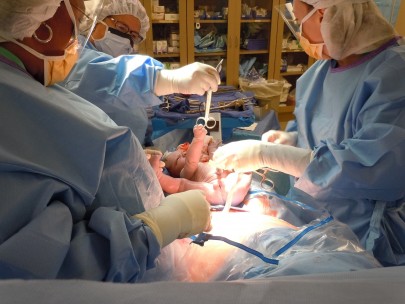
Yes, there is much that needs to be done to reduce the cesarean section rates in the U.S. Just as there is not one specific cause, there is also not one specific answer. The medical community will continue to look for ways to safely reduce this rate. Hopefully these tips will help you as the patient to make proactive decisions for a healthier pregnancy and delivery.
I am working on a future article on recovering from c-sections, so I’d love to hear from those of you who have had a c-section. What do you think was most helpful in your recovery?

Ok do I had a c section with my only child 2 years ago. I had been induced for the reasoning that my fluid was low (when my water did finally break, almost 24 hours after I was induced, the nurse said she’d never seen so much fluid, so take from that what you will) and about 32 hours street I was induced, Still at only 3cm, I was exhausted and accepted the epidural, and immediately went to sleep. 3 hours later, they decided that I wasn’t moving fast enough and decided on a c section. Everything went smoothly with that, but we were in the hospital for a week with a badly jondased little boy, which greatly helped with my recovery
I was induced at 41 weeks (no progression at all up to that point) and was in labor for 44 hours (active labor maybe 30ish hours) and pushed for 4 hours. Tried forceps, didn’t work.. (my epidural didn’t work quite well, either.. oh the agony :))That led to a c-section, and my biggest suggestion would be to stay on top of not only pain medication for the first few days, but also medicine to get you “regular” again :). Stool softener, gas-ex, etc.The most pain I experienced after the c-section was the gastrointestinal issues that kept me up at night while my baby was sleeping!
Oh, my baby was 9.6 lbs and her head was 15 1/2 inches. Explains alot. I only gained roughly 30 lbs and am a fairly small person, only 135 lbs pre-pregnancy.
I’d also love advice/tips on how to make breastfeeding easier after a c-section. I wasn’t aware that the pain meds I was taking reduced/inhibited my supply. Are there supplements a brand new mother can take to help get the milk flowing? 🙂
I was so blessed to have wonderful patient midwives. I have long labors and big/posterier babies. My largest was 10 pounds 15 oz born vaginally. Took me two pushes. He was also number 4 so maybe I’m just a birthing machine at this point. My second child took me 3 hours to push out because he just did not want to descend down the birth canal. I actually went head to head with my sister’s doctor when she delivered. She was not dialating at a rate of 1cm an hour and the baby was posterier. He also Oked her epidural when she was at 2 cm. The nurse gave me kuddos. Apparently this doctor has a 70% c section rate. My midwives and doctors like what my sister had are my inspiration to complete the nursing degree and move on to become a CNM.
I have had two c-sections. With both I seemed to feel a spark of renewal at around two weeks post c-section which caused me to overdo it a bit and kind of revert in the healing process. I would say slow and steady is important for a good recovery.
After having 4 c-sections in the last 4 years (3 of which were performed by you Dr. Rupe!) I would agree that getting up and moving was a great benefit. After my first section I spent four days in the hospital but only 2 days with the subsequent sections. The difference in time between my first and subsequent deliveries was that due to getting up and walking around in the evening after I delivered rather than staying in bed. Also taking the pain medication before I was in extreme pain was key. Thankfully my body also just heals well and scars minimally which made having my babies via Caesarian so close together doable.
Laura, thanks for your input! You are an expert on C-section recovery! We miss you around the office this year!
I had a C-section because during contractions, my son’s heart rate was dropping. While this was the right thing to do, my OB had asked me at my 12 WEEK visit when I wanted to schedule my C-section. If I have another child, I believe that I need to find another OB!
I think the best thing for me (which you can’t plan) was that I wasn’t stressed out about having a C-section. Another friend just had a scheduled C-section and she and her husband were a whole bundle of nerves before it and didn’t rest well. Since my C-section was unexpected, I was able to roll with the punches a little easier. I would agree with the other ladies, that asking for help was key to my recovery and being sure to stay active — even if it was just walking around the house. I do believe that the active lifestyle that I held before the delivery contributed to the quicker recovery. I worked out almost daily even up to the end (walking mostly).
I had a C section with my first (& only) son 14 months ago. He was 4 days past my due date, measuring 10 1/2 pounds on the ultrasound, & I was not progressing AT ALL. I was also 36 with a heart condition. The decision was a good one as he did come out 9 1/2 pounds! 🙂 The most helpful things for my recovery was having family members with me 24/7 for the first few weeks, having friends organize meals (Foodtidings.com), and the loved ones who brought practical gifts over (creams for me & baby, flushable wipes, beer for the husband, etc) 😉 Interesting blog… I’m loving it so far!
THanks Kristi, glad you found us!
I had a c-section after 4 1/2 hours of trying to push out a big, posterior baby. Two very helpful things for my recovery were getting up to walk in the hospital even though it was uncomfortable and wearing a post-postpartum belly band for a few weeks. It helped the swelling go down and made the incision area feel more secure (especially with laughing, sneezing, etc.).
oh, great idea! i wore the band, too, and it really helped with the pain.
Thanks for writing this! I’d also include hiring a doula to the list. Research has shown that using a doula during labor will reduce your c-section risk by nearly 50%.
I had an emergency c-section with my first due to his heart rate dropping. I think the biggest thing to help was to try and get moving soon. I would carefully walk the halls of the maternity ward. Also, try to line up help. Even just a couple of hours a day to make sure some laundry is done and a meal made. 🙂
I can tell you, the absolute worst thing about my csection was the stomach I got the day after leaving the hospital. Pure torture.
Last, my next two babies were VBACs. Unless other factors are present, try. 🙂
Thanks Holly! You were a great ‘VBAC’er!
I totally agree with Adriel that a few extra days in the hospital, as well as having support and people who brought meals was a God-send when it came to recovering and being able to take care of myself after my C-section. And for anyone who might not have that kind of support close by, in the month or two leading up to my due date, I would often make extra at meal time then put it in the freezer so we had access to quick homemade meals and didn’t have to spend a lot of time in the kitchen or eating fast food.
Despite following all of your above mentioned recommendations, my second baby came via C-section after 32 hours of labor and still only being at 7cm with her head not engaged at all. During the surgery they found the cord wrapped twice around her neck and think that was what was holding her up in there. It was quite a disappointment to both me and my husband. But it was helpful when I was able to talk through the disappointment with a friend who had gone through something similar.
That’s my friend Priscilla getting the version and Dr. Tucker here at Townsville Hospital! Just a little fun fact for you. I didn’t know how famous she was. 🙂
I had an emergency c-section with my first due to him being undetected breech (until 12 hours into labor when I checked myself in). I was pretty bummed out that it was missed (and I couldn’t try a version like Priscilla!), and yet I was also a breech baby born by c/s so always had that in the back of my mind as a possibility. My recovery was actually much easier than I had expected. I had to stay in the hospital for five days following the surgery, which is several days longer than normal, but I kept having a fever come and go and possible infection so they kept me in. As much as I wished I could just get home I look back and absolutely thank God for that time. I’m convinced that five days of total rest is what kick-started my recovery to be so relatively fast/easy. I know had I been home I would have wanted to get all nesty, take my baby out to show everyone, etc. Having that forced rest at the very beginning was the best thing that happened to me in terms of post partum recovery. I would also hope c/s mama’s can get meals from friends for a couple of weeks and hubby to have some time off of work (or a mom nearby) to be a support, look after the house, and make sure you’re following doctor’s orders (resting!). I also think talking through the disappointment openly or with a support group or counselor (if there was any) is important to moving forward. All birth needs to be celebrated but some moms have a hard time when they are so disappointed… and that leads them to feel guilty. And no new mom needs more reasons to feel guilty!
As for avoiding a c/s in the first place, I’m surprised you didn’t mention aiming for natural childbirth since many of the interventions snowball into one another, ultimately leading to c/s. You did mention holding off on an epidural for longer, but what about avoiding it and other drugs all together? C/s rates following natural childbirth attempts surely would be a much lower rate that the norm??
And wow, Heather, that photo is amazing!!! What a little go-getter! You’re such a wonderful doctor. Wish you were in our hospital!
Adriel, what a small world that your friend is in the random you tube video I picked! {If only all versions went as smooth as that one!)
Whether epidurals increase the c-section rate will likely always be debated! There is no way to get a truly scientific study, you can’t really take 1000 women in labor and say to half you HAVE to get an epidural and the other half you CAN”T an epidural.
The majority of the women who choose natural childbirth also choose healthier lifestyles and stay active (which also lower c-section rate).
However, the study I referenced compared women who got their epidural’s after 4 cm had lower c/s rates than those before 4 cm.
yeah, that makes sense re natural childbirth + healthier lifestyles. a generalization, but i think a good one. and i totally see what you’re saying about getting an accurate study by saying “you – epidurals! you – no way, jose!” probably wouldn’t go over that well with most moms. 😉
and i know – crazy about my friend, right? just us here in a little old town in far north australia! and yeah, it was an awesome example. he told her that if he can’t do it in a couple of minutes, then he won’t do it – gets too stressful for the baby. but he’s got a really high success rate here. fascinating stuff! (and my friend said it’s not as painful as it looks!)