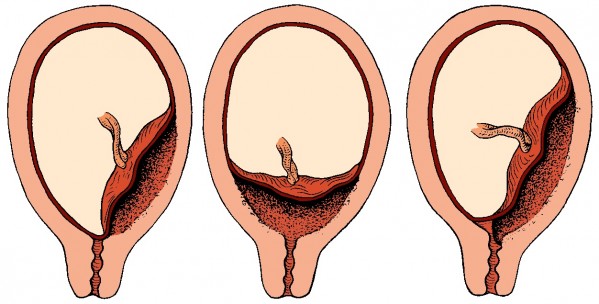
The placenta is an under-appreciated organ.
It is the lifeblood of the baby. Faithfully, it supplies nutrients, fluids and oxygen for 9 months. Then as soon as the cord is cut, it’s thanklessly discarded.
The placenta is a disposable organ. While there are several vestigial organs, the placenta is the only one that is actually disposable.
After I deliver a baby, I carefully examine the placenta to make sure that no piece was left behind. I often ask the mom at delivery if she wants to see her placenta. Some say yes. Most wrinkle their nose at the bloody heap in the pan, say ‘no thanks’ and turn their attention back to their adorable baby. That’s understandable, but the placenta truly is fascinating.
The placental tissue is shaped like a disc. The disc is made up of individual ‘cotyledons’ which are smaller circles within the larger circle that abut against each other. It is brownish red with a texture that can only be described as ‘liver meets berber carpet’. When the placenta lays flat, it appears to be one solid unit. But when you hold it up by the membranes and it forms its natural shape, you can see how each individual unit fits together.
The disc’s attachment to the uterus is where the maternal blood and baby blood exchange oxygen and nutrients. The mom’s blood and baby’s blood DO NOT TOUCH. The umbilical cord is attached to the placenta and it carries these nutrients directly into the baby’s blood stream. The amniotic membranes (bag of water) adhere to the placenta as well as the uterus.
8 Random (Yet Fascinating) Placenta Facts:
1. The placenta secretes hormones. When you feel like a ‘hormonal mess’ during pregnancy, you can totally blame that on the placenta. It also secretes IGF-1 (insulin growth factor), which is what causes gestational diabetes.
2. Every minute of your pregnancy, 1 pint of blood is pumping into the uterus, exchanging nutrients with the placenta.
3. The placenta also secretes HCG. You can actually thank the placenta when your pee stick turns that pretty shade of positive pink.
4. The food you eat does not go directly to the baby. It is broken down into tiny particles of proteins and nutrients that cross the placenta. So if you are eating nutrient deprived food, you are not feeding your baby.
5. Amniotic fluid is just baby pee.
6. The placenta can weigh up to 2 pounds, so it can be blamed for A LITTLE of your weight gain.
7. Babies do not breathe amniotic fluid. Oxygen also diffuses across the placenta into the fetal blood, traveling through the umbilical cord into the baby’s circulation.
8. Placentas are also a great weight loss tool. Don’t believe me? Before your next meal go to Google images and type in the word ‘placenta.’ I guarantee you won’t eat very much after that.
No, I don’t expect you all to be as fascinated with the placenta as I am. But perhaps at some point on your journey, you can take a moment to digest what an awesome God we have that created so perfect an organ.
“I praise you because I am fearfully and wonderfully made; your works are wonderful, I know that full well.” Psalm 149:14
Did I convince you at all that the placenta is interesting or do you still find it to be a gross blob?
It’s awesome….. The body is amazing….
Interesting and unique article…
Pregnancy is truly a miracle!
I am very glad I asked to see the placenta on my 2nd delivery; my husband was not so glad. It’s was interesting & neat to see!! Thanks for reminding me how truely awesome God’s design for our bodies is!!
I think that seeing it and knowing it has come out of you somehow helps you to feel more clean and better knowing it has left your body.
Thats a pretty simple way of breaking it down but its easy to remember and I dont think many people know that. Its a wonderful thing but at the same time it can gross me out!
So, when your water brakes, it’s baby pee?
Essentially yes.